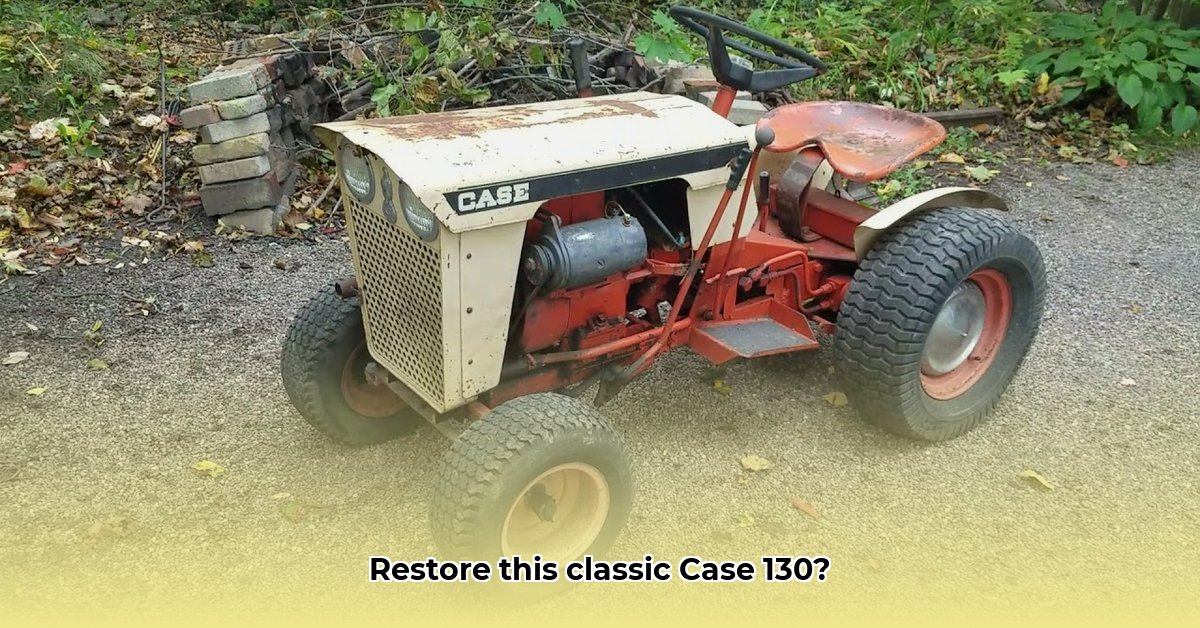
Case 130 Garden Tractor: A Rare Find and a Rewarding Restoration
The 1965 Case 130 garden tractor isn't your average lawnmower; it's a piece of living history. Its low serial number—a testament to its early production—makes it a rare and highly sought-after find for collectors. But what truly sets this machine apart? Its innovative hydrostatic drive system, a game-changer for its time. This revolutionary system directly connected the hydraulics to the engine, eliminating the cumbersome belts and driveshafts common in its contemporaries. Think of it as a surprisingly sophisticated ancestor to today's zero-turn mowers—a marvel of engineering for the mid-1960s. For more Case tractor specs, check out this helpful resource: Case Tractor Specs. This guide will walk you through the rewarding, yet challenging, process of restoring this legendary machine.
A Look Back: Case, Colt, and the Garden Tractor Boom
The Case 130's story begins with Case's acquisition of Colt Lawn Tractors in the midst of a booming garden tractor market. The demand for efficient lawn and garden care exploded in the mid-1960s. The Case 130, equipped with its revolutionary hydrostatic drive, quickly rose in popularity. This wasn't merely about convenience; it marked a significant technological leap. Unlike its clunky, gear-based or belt-driven competitors, the Case 130 offered unparalleled smoothness and control. This technological advancement provided a distinct advantage in a rapidly expanding market.
Under the Hood: The Engine and its Unique Transmission
The Case 130 houses a reliable 10-horsepower Kohler 391cc single-cylinder engine, a workhorse known for its durability. However, it's the hydrostatic transmission that truly distinguishes this tractor. This system provides infinitely variable speeds, eliminating the jarring gear changes of its predecessors. Imagine effortlessly adjusting speed, both forward and in reverse, with a simple lever twist. This intuitive control was remarkably advanced for its era. Coupled with a sturdy frame and user-friendly controls, the Case 130 represents a well-engineered machine. Isn't it fascinating how much technology has advanced in such a short period?
Bringing It Back to Life: The Restoration Journey
Restoring a Case 130 is a rewarding project, however, it presents significant challenges. Success requires patience, resourcefulness, and a degree of mechanical aptitude. Let's explore the key aspects of this restoration:
Part Sourcing: The Treasure Hunt
Locating parts for a nearly 60-year-old tractor presents a unique challenge. Online forums dedicated to vintage tractors are invaluable resources. Connecting with experienced enthusiasts often yields parts or crucial advice. Specialized dealers catering to classic machinery offer another avenue. Finally, 3D printing provides a modern solution for less critical parts. Have you considered the potential of 3D printing to revive the Case 130's legacy?
Common Problems: What to Expect
The innovative hydrostatic transmission is often the most significant hurdle. Leaks, worn seals, and potential pump failures are common culprits. This system demands careful attention and may require specialized knowledge or professional assistance. While generally robust, the engine itself may need attention. Focus on the carburetor and ignition system for reliable performance.
Maintenance: Keeping It Running
After the restoration, diligent maintenance ensures your tractor's longevity. Regular oil changes, clean air filters, and a sharp blade are essential. Critically, pay close attention to the hydrostatic system; regular fluid checks are vital. What simple preventative measures can you take to extend the life of your restored Case 130?
Value and Collectibility: A Unique Piece of History
Precisely valuing a Case 130 proves difficult. Its rarity is undoubtedly a major factor, with limited production numbers. Several key elements influence the final price: the tractor's condition, originality (proportion of original components), and even the completeness of its documentation all contribute. The absence of precise production figures adds uncertainty to any valuation. However, these early models are highly sought after by collectors, making your restoration a unique and potentially valuable investment in agricultural history.
Addressing Potential Challenges: A Practical Guide
The following table details common challenges and mitigation strategies:
| Component | Potential Problems | Mitigation Strategies |
|---|---|---|
| Hydrostatic System | Leaks, pump failure, worn components | Thorough inspection, maintenance, rebuild/replacement |
| Kohler Engine | Carburetor issues, ignition problems | Routine maintenance, cleaning, part replacement |
| Bodywork | Rust, paint deterioration, damage | Cleaning, rust treatment, repainting, part replacement |
| Parts Availability | Sourcing difficulties | Online forums, specialized dealers, 3D printing, salvage yards |
Conclusion: More Than Just a Mower
The Case 130 transcends its function as a simple machine; it embodies a pivotal moment in garden tractor innovation. Its restoration is a journey of dedication and ingenuity, and a testament to the enduring appeal of vintage machinery. It's also a chance to connect with history and a community of passionate enthusiasts. Are you ready to embrace the challenge and uncover the story within one of these remarkable machines?
Step-by-Step Restoration Guide
- Disassembly: Meticulous documentation (photos!) is crucial.
- Cleaning: Thorough cleaning of each component.
- Repair/Replacement: Address damage and replace worn parts.
- Reassembly: Carefully follow your documentation.
- Testing: Thoroughly test all systems.
- Finishing Touches: Accurate paint codes and decals ensure authenticity.